The stand-in for the survivor now leaves boot prints in the snow, and new snow fills them in over game hours. Light snow closes a trail in about three hours, a blizzard in about a quarter of an hour.
The bought prints barely showed
The snow package we bought can stamp footprints, so we tried it first and planted a print under each foot as the stand-in walked. Nothing showed. The package had stored all 13 prints in the right places, and every setting we checked was on. So we rendered the same frame with the package on and off and amplified the difference six times. While the game ran it drew a very faint snow texture, faint because the ground under it is already painted as snow. Its prints also fade within four minutes of real time, far too soon for tracks that should last until new snow covers them.
Our own prints
So we draw our own. Each print is a flat card laid over the snow, and the dent is worked out as it is drawn: a boot sole, a raised rim and tread. It takes its light from the sun or the moon and the sky, so it reads in sun, under cloud and at night. At 6 cm deep the trail barely read from the game camera. At 9 cm, with a shallow hollow round each sole where the leg pushed the powder aside, it does. Prints fall left and right about 70 cm apart, and a whole trail is at most 400 of them, drawn in one go.
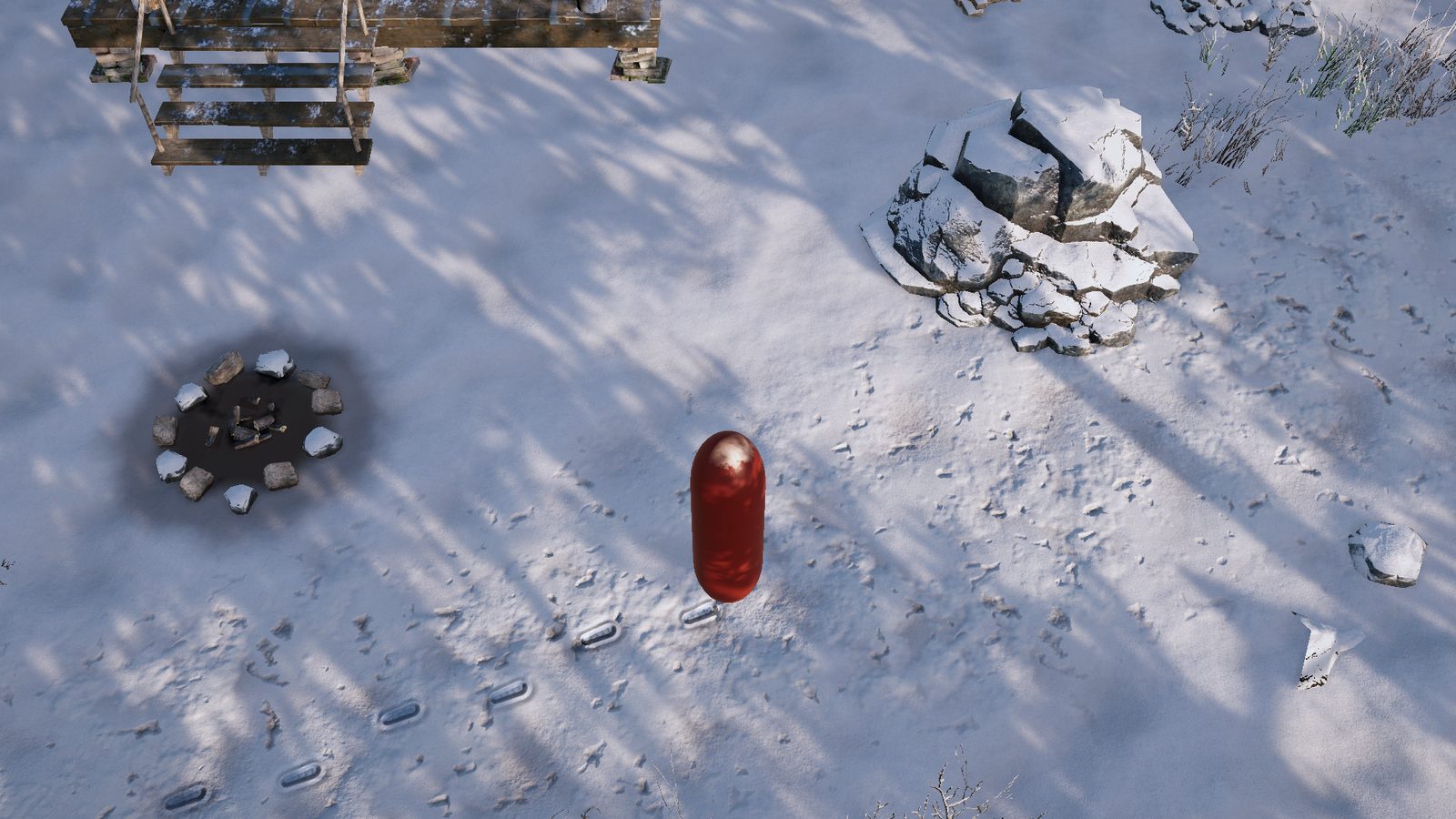
The weather fills them in. A clear day keeps a trail, and heavy snow fills it in about 50 game minutes. These rates get tuned once there is a game to tune them in.
Snow kicked up by a step
Walking should also move the snow around. As a foot lifts, its toe now kicks 8 to 14 small clumps forward. They fly, land on whatever is there and settle, and a puff of powder drifts off with the wind and thins out. The landing foot puffs a little too. Each print keeps a furrow where the toe dragged and a few lumps it kicked out, different from print to print.
White on white was the hard part. Particles lit flat, the usual way, vanish against the snow. So each bit of thrown snow is shaded as a small ball of snow with a lit side and a shaded side, and the shaded side is what you see against the snow. The first clumps came out as perfect round balls. They now have ragged outlines, turned at random, and are smaller. At most 200 bits of snow fly at once.
Up close it reads well. From the game camera it is subtle, as real snow is. In a blizzard the wind takes the powder away and the prints fill quickly behind the walker.