In a blizzard the view now closes to a circle of about 8 m round the survivor, with only white and blowing snow beyond it. The last passes of the look test went into bad weather and the low winter sun.
Snowfall on the graphics card
The falling snow was the largest single cost on the main thread, about 2 ms per frame in a blizzard. Now the graphics card places every flake itself, from the flake's own seed, the time and how far the wind has carried it, inside a box that moves with the survivor. Up to 80,000 flakes fall at once. Measured in the same build, a blizzard's main-thread time went from 8.0 to 5.8 ms, the same as a clear day, and the graphics card pays about 0.2 ms more.
Smoother edges, snow light and thin snow
The game camera had no edge smoothing at all, so grass, branches and roof edges stair-stepped and shimmered in motion. Smoothing them now costs about 0.45 ms on the graphics card. The light from below used to be a fixed grey. Fresh snow throws back about 80 % of the light on it, so the shaded sides of trunks, rocks and the stand-in now lift on a clear day and barely change at night.
The snow also thins under the trees. A crown catches the falling snow, so grass, twigs and litter show round the trunk, and the wind strips the tops of rises and the slopes that face it.
The view closes in
Our first blizzard fog reached 80 % only at 20 m, so a cabin 13 m away showed clearly. Bad weather now closes the view to a circle round the survivor. The fog reaches 90 % at about 8 m in a blizzard, 18 m in heavy snow, 30 m in fog and 50 m in light snow. Gusts close it further, and sheets of blowing snow make the edge ragged, so now and then you glimpse a tree or the cabin beyond. A fire or a lit window still glows through. Skipping the flakes lost in the whiteout cut a blizzard's extra cost on the graphics card from about 1.25 to 0.85 ms.
Beyond that circle the whiteout first stood still, because the fog painted over every flake out there along with the ground behind it. The snowfall is now drawn after the fog and fogs itself, so soft flakes stream across the white with the wind.
Weather that turns
The look-test plan asked for two videos, a blizzard rolling in and dusk turning to night. Weather could not change at all, so it now blends from one kind to another with every part moving together. Mixing the fog in a straight line kept the view clear until the very end, since a clear day lets you see about 250 m and a blizzard about 4 m. Now the view halves at a steady rate.
Facing the sun
We built glare toward a low sun in the second pass and never saw it. Our camera looks north-east, and the March sun stands in the south-west. With the camera turned to face the sun at 14:30, the snow toward it takes a warm sheen, everything stands backlit and the shadows run toward you. From that side the pines near the camera reach into the frame.
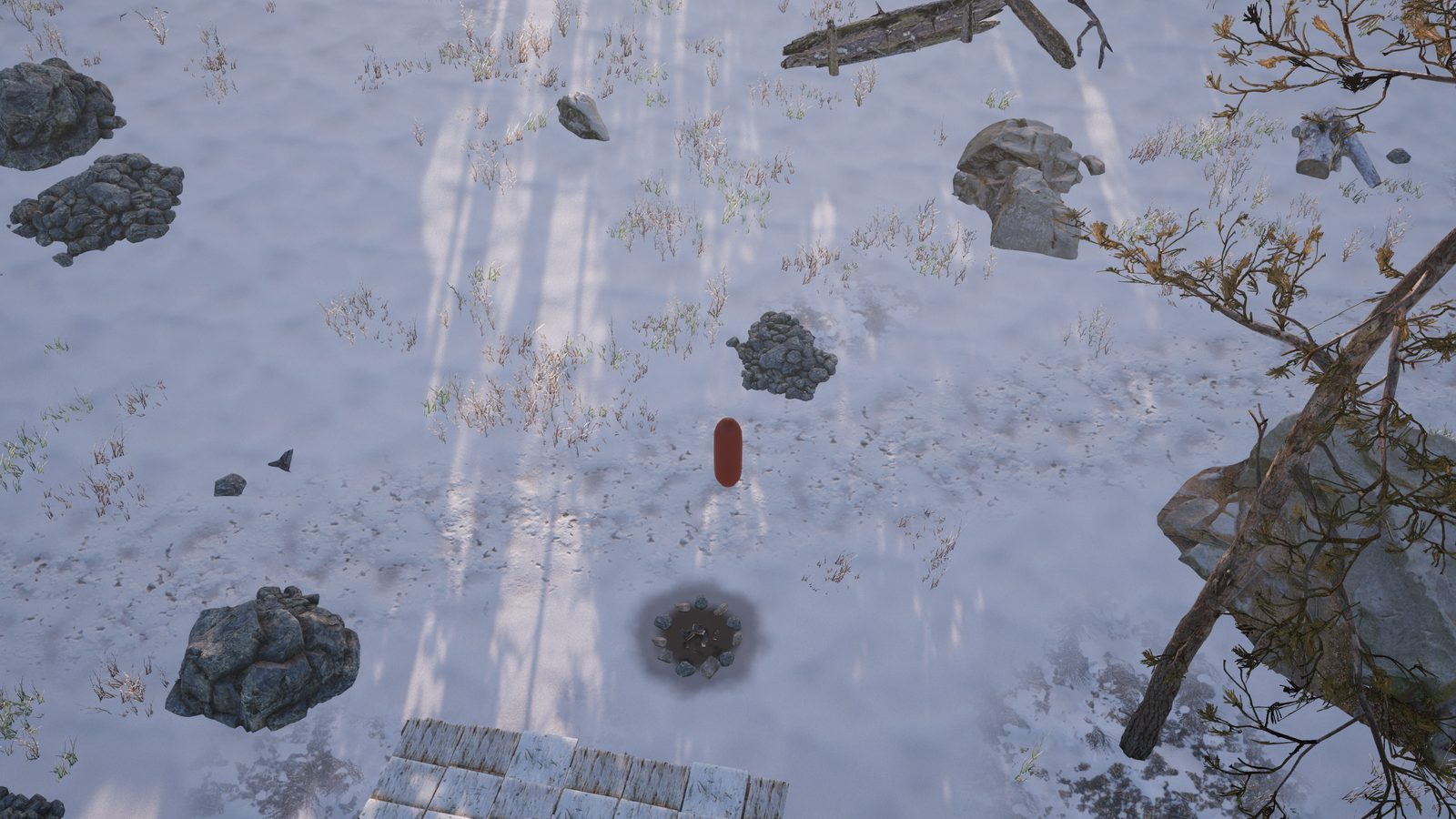
Last, we measured the plan's first bar. We checked 14 full-size frames covering clear noon, late afternoon, overcast, night, torchlight, a lit cabin and facing the sun, and no pixel reached 250 out of 255. Faint rings in the fog round a lantern at night went away once the camera dithered its output, and no seam shows in the shadows at the two closer camera distances.