Frostwake is a survival game seen from above, set in a frozen sub-arctic valley and about cold, hunger, fire and wildlife. We had built it twice before. On 5 October 2026 we started over from an empty project, and this time the first job was to decide how it should look.
Two prototypes
The first version ran in a web browser. The second was an earlier try in Unity. Our notes on the browser build said it did not feel immersive. The player figure was static, clothing did not show, and the same props repeated everywhere.
Reading the Unity version again, we found its look came from what went into it. It used low-poly art on a flat plane, near-default lighting, no snow shader, no weather and no colour grade. Its plan had a step for higher-detail art and a check for whether that looked enough better. Neither was ever tried.
What we kept and what changed
We kept the camera above the survivor. We considered first-person, which brings the weather close, and turned it down because it would put Frostwake too near a game that already does it well. We also weighed a painterly style and chose realistic art. Low-poly is out. Immersion and visuals come first this time, from the first build on, instead of as polish at the end.
We put 18 screenshots from the games we use as reference on one board and picked as our anchor the look we expect to be easiest to build.
The look test
Before any gameplay, we set out to build one corner of the valley, about 250 m across, and judge how it looks. It has a forest edge of pine and birch, a log cabin, a path, a woodpile and a fence. The plan lists six states to capture: a clear midday, an overcast afternoon, dusk, a blizzard by day, a clear night with the cabin glowing, and a blizzard at night with a lantern. Two videos come on top, a blizzard rolling in and dusk turning to night. There is no gameplay, no interface and no character.
The look test also settles the engine. It runs in Unity. If Unity cannot reach the bar, we build the same scene in another engine for a week and compare. Besides the reference shots, the bar has checks we can measure. Snow must read white without burning out, shadows must show no seams, fog must show no banding, and the frame time gets measured.
We judge every pass from captured pictures and clips, next to the same reference shots, at a matched time of day and weather.
The first pass
We bought five art packs: a snow package, a weather package, winter trees, rocks and a log cabin.
The first pass placed 1,516 trees and 140 rocks, with the cabin by the path. Trees between the camera and the survivor went black, because the camera sat inside their crowns, so we now keep that strip of ground clear. The snow package's defaults read as grain, and its frost effect whitened the corners of the screen. We turned its sparkle and bumps down and switched its frost and its own snowfall off.
The weather package showed the same sun at every hour. Our capture had opened paused on its first frame, so time never moved. Once it ran, the sun followed the clock, 15 degrees up at 10:30, 17 at 13:00 and 9 at 15:30. That is a real early-March sun at 65 degrees north, low all day. The first grade left the snow grey under it, and we raised the exposure until it read as daylight.
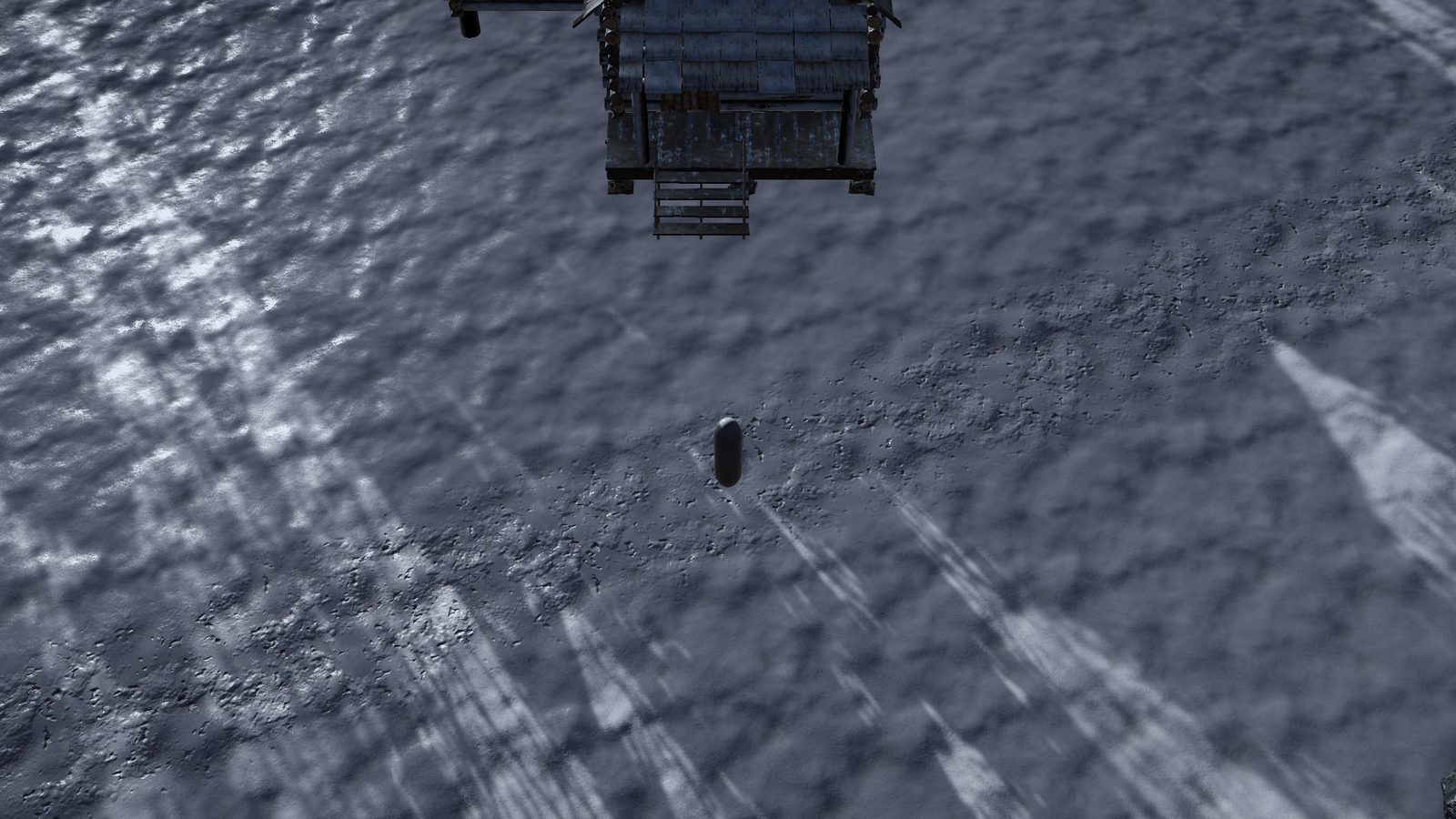
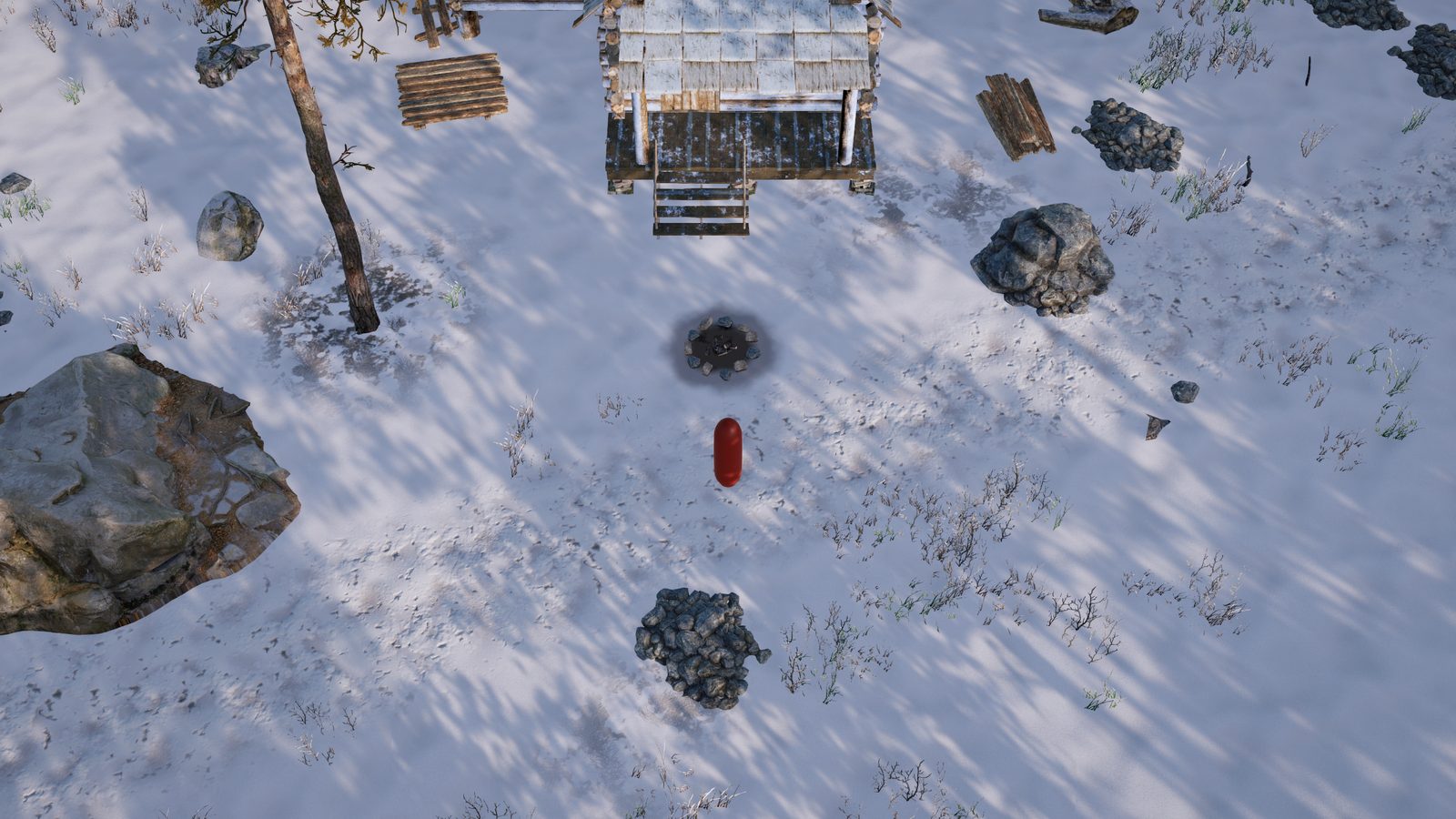
After the first pass we judged the shadows good, the ground lumpy and too glossy, and the valley short of variety. We also chose the camera. Of the three distances we tried, the closest gave the most immersive view, 22 m from the survivor and looking 50 degrees down.