We want Frostwake's weather to change from day to day, a high clear sun one morning and a blizzard that hides it the next, with the player planning around it. So the look has to hold up in every kind of weather, and from the second pass on we judged a full set, from clear to blizzard, at the same place and hour.
How high the sun climbs comes from the calendar date, so a long game would move from a low midwinter sun toward a higher spring sun.
The bought weather barely showed
We bought a weather package for the sun, sky, fog and snowfall. In our scene every weather looked alike. One by one we found that its weather zone ships switched off, that a zone only applies once a player stands inside it, and that our camera only drew a frame at the moment of each capture. With those fixed, the package's own demo scene showed a real blizzard, and ours still read as a light haze. The package is built for a camera at eye level. Its fog is tuned for views across hundreds of metres, it never dimmed the sun under overcast, and the sky it draws best is never on screen from above.
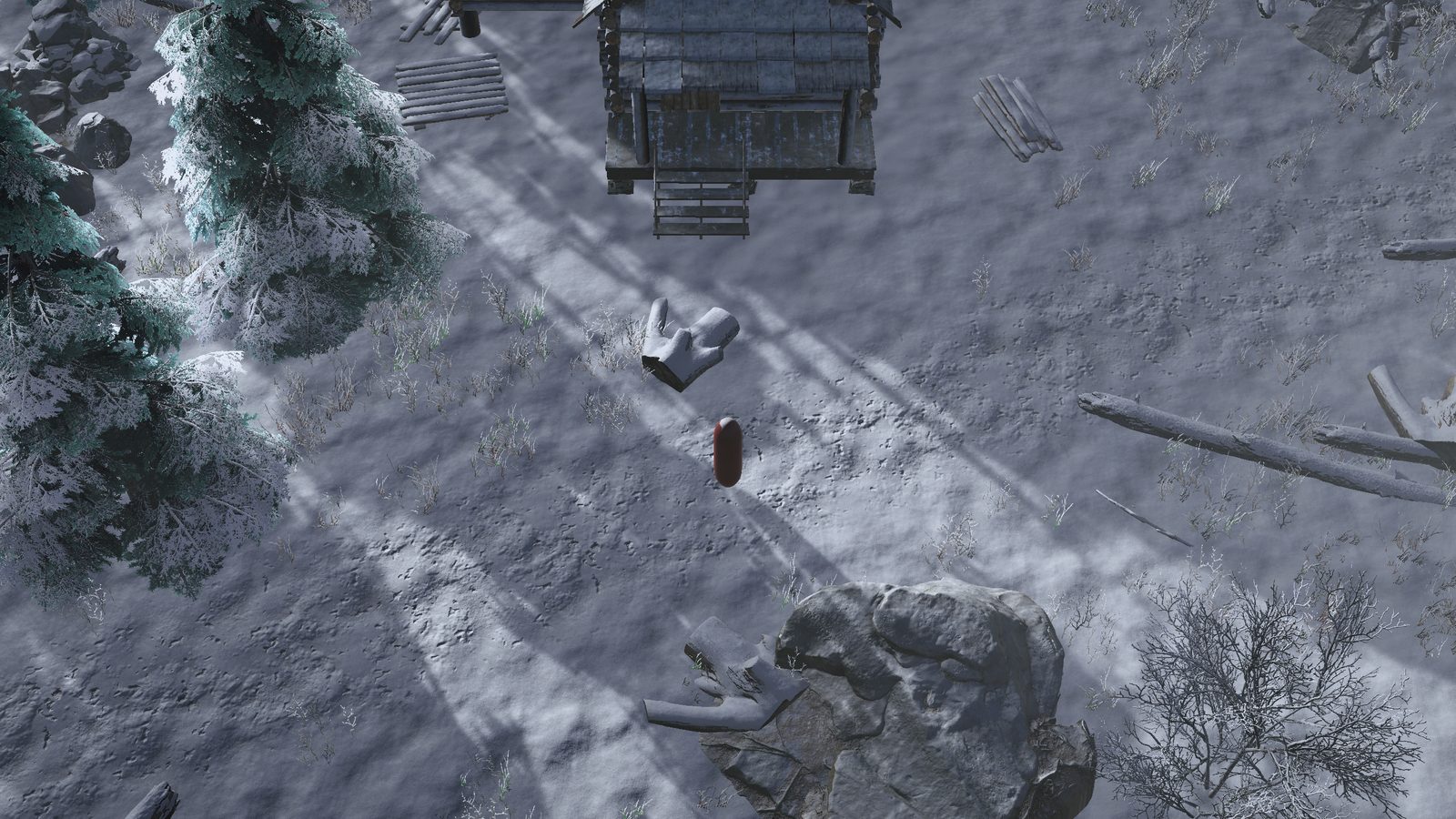
So we built our own weather layer for a camera above the survivor. Its fog grows with distance from the survivor instead of from the camera, which hangs about 22 m away whatever the weather. Fog measured from the camera would hide the survivor first. Each weather sets how strong the sun is and how hard its shadows fall, and the wind drives the falling snow.
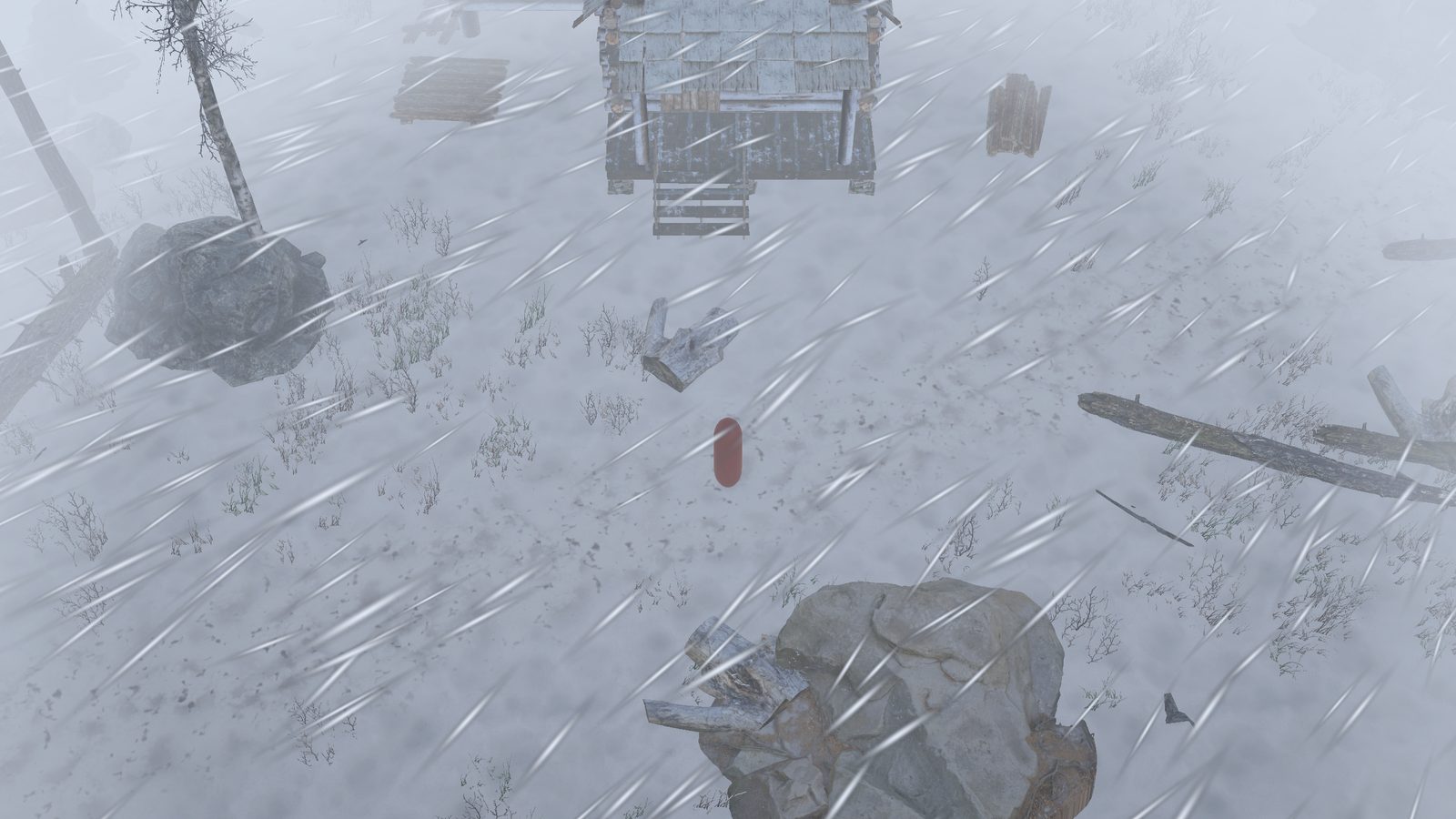
The sun's place in the sky comes from a standard astronomy formula for the date, hour and latitude. Checked against the weather package's own sun at six hours, it agreed within a quarter of a degree. Later that day the moon got the same treatment, with its real path and phase. It sits beside the sun at the annular solar eclipse of 17 February 2026 and opposite it, full, at the total lunar eclipse of 3 March. Our test date is 1 March, two nights before full moon, so the clear nights are bright. Under cloud the night goes dark.
Snow and trees
The lumps in the first pass came from the snow package's surface noise, which repeated every 10 m, and the glare from a surface far too glossy. The snow now has fine detail on a 3 m repeat and a matte finish. For variety we added grass tufts, fallen trees, stumps, roots, rocks, bushes, young pines, a woodpile and a fence.
The first capture of every run had drawn placeholder shaders, because the engine had not finished preparing the real ones. That made the bought pines look broken, and we dropped them by mistake. Once captures waited for the shaders the pines looked right, and Scots pines became the main tree. At the 16 to 28 m they came with, they put our camera inside their crowns, so they now grow 9 to 20 m, about right for a northern pine heath.
Nothing inside anything
The second pass looked good, except that objects stood inside each other. A birch grew out of a boulder and logs ran through stumps, because every scatter placed its objects without looking at what was already there.
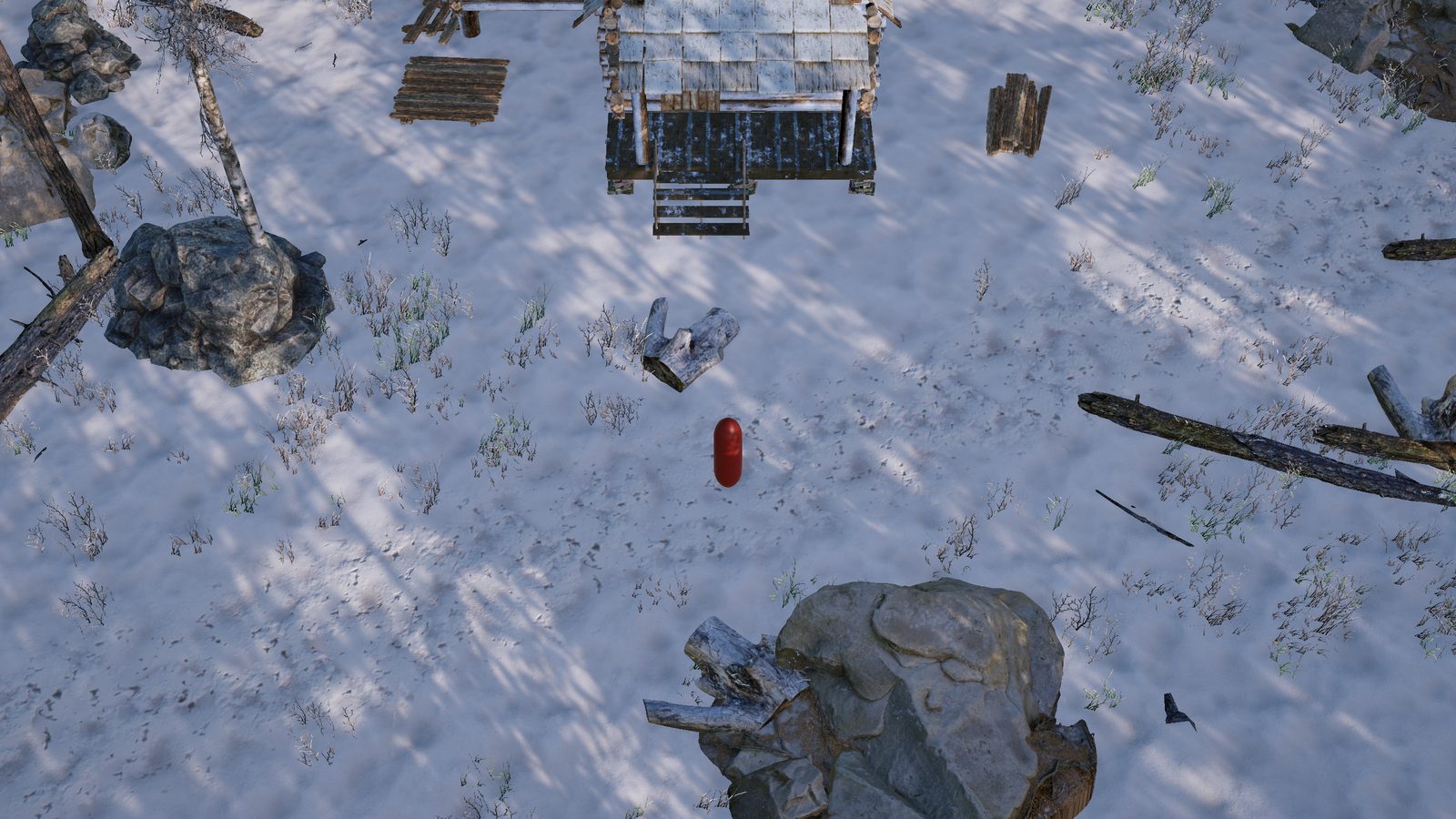
Now every object claims its patch of ground. The cabin and its clutter go first, then boulders and rocks, then trees, then stumps, logs and grass, and anything that would overlap a solid already placed is left out. The first version claimed squares lined up with the world, so a log lying at 45 degrees blocked the whole square around it. The patch now turns with its object.
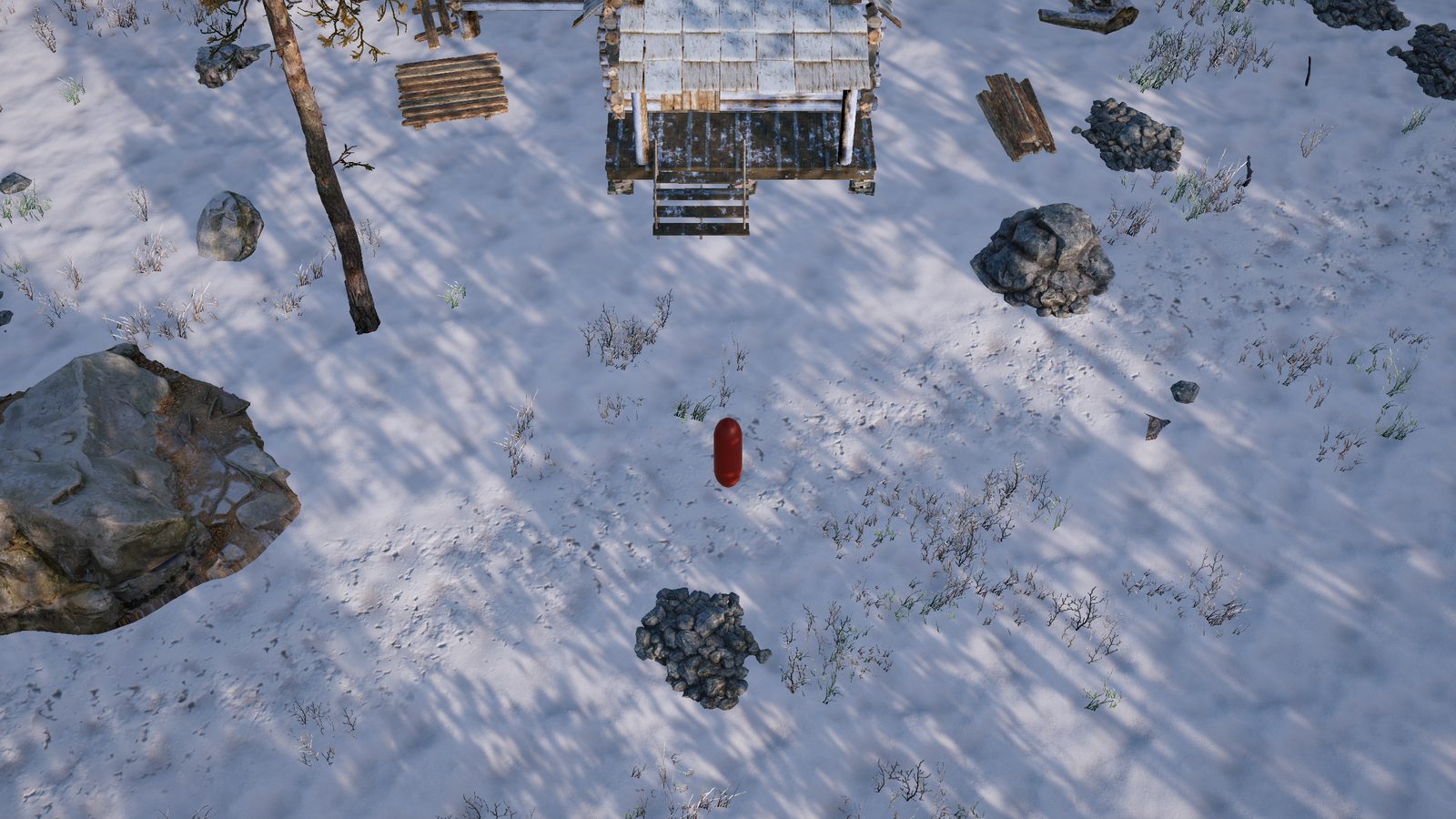
Young pines and bushes now stay out of the first 14 m between the camera and the survivor, where one had filled the bottom of the picture.